

1 vs 2 Drive Crane VFD Control
In the automation retrofit of cranes, the choice of variable frequency control architecture directly impacts operating efficiency and energy consumption performance. Industry measured data indicates that bridge cranes using one-inverter-to-two-motor (one-to-two) control can reduce overall energy consumption by approximately 15%, whereas one-inverter-to-one-motor (one-to-one) control improves the dynamic response speed of individual mechanisms by about 20%. This article analyzes the core differences between these two control modes in terms of architecture, installation processes, and cost accounting to provide engineering technicians with a reliable selection reference.
Control system design must strictly adhere to the electrical drive and control requirements outlined in FEM 1.001 Crane Design Standard to ensure stability under complex operating conditions. Additionally, per the TSG 51-2023 Crane Safety Technical Supervision Regulation, frequency inverter selection and parameter settings must satisfy specific safety protection logic to prevent mechanical loss of control caused by electrical faults.
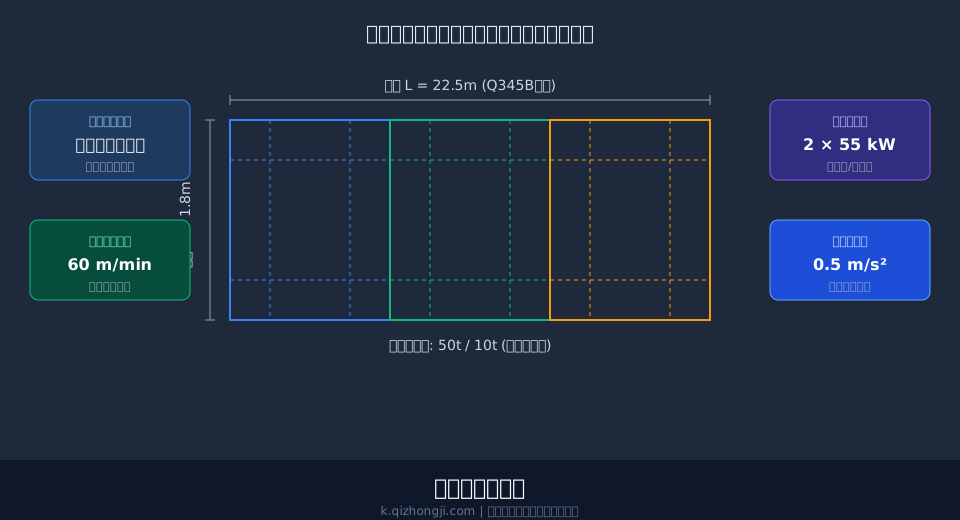
This article comprehensively analyzes the differences between one-to-one and one-to-two variable frequency controls across five dimensions: system architecture, Installation & Commissioning, cost accounting, fault maintenance, and engineering case studies, helping you clarify the technical framework for automation retrofits.
Core Differences in Architecture Between One-to-One and One-to-Two VFD Control Systems
In crane electrical drive systems, selecting the variable frequency control architecture is the primary step in an automation retrofit. One-to-one control uses a single frequency inverter to drive a single electric motor, a configuration widely used in traditional single-girder or small double-girder cranes. One-to-two control uses a single inverter to drive two motors alternately or simultaneously via switching contactors or vector control algorithms, commonly applied to long travel or trolley travel mechanisms. The Kelude technical team notes that hardware topology differences directly determine system redundancy and control accuracy.
Hardware Configuration Differences: In a one-to-one system, each motor requires an independent 75kW frequency inverter and a corresponding braking unit. This high hardware redundancy ensures that a single point of failure does not affect other mechanisms. Conversely, a one-to-two system typically uses a single 110kW inverter to drive two 55kW motors, reducing the number of inverters but increasing the switching contactor group on the output side.
Control Logic Differences: One-to-two systems must manage load balancing between two motors. In dual-drive long travel mechanisms, unsynchronized motor speeds can cause severe rail gnawing (wheel flange rubbing). Therefore, one-to-two systems require master-slave control or circulating current control algorithms to ensure balanced torque distribution. This is often integrated with anti-collision safety distance settings to enhance operational safety.
"Industry measured data shows that under rated load, the synchronized operation of dual motors in a one-to-two system reduces the peak starting current of the long travel mechanism by approximately 22%, effectively mitigating stress on the workshop power grid."
⚠️ Note
In one-to-two architectures using contactor switching, never operate the contactors while the inverter output is not fully locked. Doing soHighly Susceptible causes inverter module failure.
Electrical Wiring and Commissioning Processes for Automation Retrofits
Electrical wiring and commissioning processes directly determine the long-term operating stability of variable frequency control systems. On-site teams must strictly follow the electrical schematic during wiring, ensuring signal cables are separated from power lines to avoid high-frequency harmonic interference. Different control architectures have distinct requirements for cable specifications and commissioning workflows.
Wiring Complexity: Retrofitting a one-to-one system involves relatively simple power cable laying, typically using 25mm² copper-core cables to connect the inverter directly to the motor. In contrast, one-to-two systems involve switching or parallel connections for two motors, requiring a switching contactor group at the inverter output. This results in more complex cable routing, necessitating twisted-shielded pairs for encoder feedback signals to ensure integrity.
Commissioning Cycle Differences: Parameter setting for one-to-one systems is straightforward, with self-learning and optimization taking about 4 hours. One-to-two systems require complex parameter matching, particularly for current balance debugging under no-load conditions, extending the cycle to 8–10 hours. During this process, if mechanical structural issues are suspected, weld crack detection should be performed to ensure the main girder strength meets the requirements for dual-drive synchronous loading.
"According to electrical installation standards, encoder feedback lines for one-to-two systems should not exceed 30 meters. If exceeded, signal repeaters must be added to prevent speed loop oscillation caused by signal attenuation."
💡 Tip
When tuning circulating current control parameters for one-to-two systems, start with a low proportional gain (P) and gradually increase it until the system response is stable. Avoid excessively high initial parameters that could cause severe impact on mechanical transmission components.
Cost Accounting and Return on Investment Period for VFD Selection
During the project initiation phase of an automation retrofit, cost accounting is critical. Enterprises must comprehensively evaluate initial procurement costs, Installation & Commissioning fees, and subsequent energy consumption and maintenance costs. One-to-one and one-to-two configurations exhibit different return on investment characteristics; proper selection helps control the overall retrofit budget.
Initial Hardware Procurement Cost: A one-to-two system reduces the number of inverters, lowering initial equipment procurement costs by approximately $1,800 (specific amounts are subject to the actual contract). Reduced component counts in the electrical cabinet also lower manufacturing costs. However, one-to-two systems require high-precision switching contactors and balancing reactors, adding incremental costs that must be factored into the budget.
Lifetime Energy Consumption and Maintenance Costs: One-to-two systems automatically switch to single-motor operation under light load conditions, reducing overall energy consumption by approximately 15%. When providing customized retrofit solutions, Kelude Heavy Industry uses simulation software to model actual operating conditions, precisely calculating energy differences to determine the payback period. Typically, the static payback period for a one-to-two solution ranges from 1.5 to 2 years.
The table below provides a detailed cost comparison of the initial investment structure for one-to-one versus one-to-two Frequency Inverter (VFD) control systems, focusing on hardware procurement and installation & construction phases to assist in project budgeting.
📊 Initial Investment Cost Comparison: VFD Control Systems
| costProject | 1-to-1 Configurationcontrol systemSolution | 1-to-2 Configurationcontrol systemSolution | costVariance Analysis |
|---|---|---|---|
| Frequency Inverter / VFDProcurement | 2Unit(s) × 75kW | 1Unit(s) × 110kW | 1-to-2 Approx. Savings15%Hardware Costs |
| SwitchingContactorGroup | None | Increase4Large Group CapacityContactor | 1-to-2 Approx. Increase0.310,000 RMB |
| control cable | 2 × 25mm² | 1 × 50mm² + Switching Line | Roughly Flat |
| Installation & CommissioningLabor | Approx.8Man-hours | Approx.16Man-hours | 1-to-2 Configurationlabor costDouble |
Financial analysis of a major metallurgical workshop retrofit project indicates that implementing a one-inverter-to-two-crane (one-to-two) variable frequency drive (VFD) scheme saves approximately $670 USD in electricity costs per crane annually, boosting the overall return on investment (ROI) by 12%.
⚠️ Note
When performing cost accounting, do not overlook the potential downtime risks associated with contactor switching in one-to-two systems. For workshops requiring high continuity in production, it is recommended to increase the budget weight for the one-inverter-to-one-crane (one-to-one) solution.
Common Electrical Fault Diagnosis and Maintenance Strategies in One-to-Two VFD Control Modes
Stable operation of variable frequency control systems relies on scientific maintenance strategies. Due to complex electrical topology involving multiple motors and switching mechanisms, fault diagnosis for one-to-two systems is more challenging than for single-motor setups. Establishing a standardized maintenance system effectively reduces unplanned downtime and ensures production continuity.
1. Analysis of Common Fault Codes
In a one-to-two system, an OC (Over Current) fault code requires checking if load distribution between the two motors is balanced. If resistance increases on one side, the motor current spikes; improper deceleration control parameters may cause the Frequency Inverter to misinterpret this as a short circuit and trigger protection. Based on Kelude Heavy Industry’s extensive field experience, prioritize inspecting wear on mechanical transmission components in such scenarios.
2. Defining Maintenance Cycles
We recommend conducting wear inspection on the switching Contactor contacts every six months and cleaning dust from the Frequency Inverter’s heat dissipation air ducts. Additionally, leveraging modern automation technology, contemporary VFD systems can integrate AI anti-sway algorithms. By real-time monitoring minor fluctuations in motor current and rotational speed, these systems provide early warning for potential machinery faults.
The Equipment Maintenance Manual explicitly states that the difference in Insulation Resistance values between master and slave motors in a one-to-two system should not exceed 10%. If this threshold is exceeded, immediate drying or insulation treatment of the motor stator winding is required.
💡 Tip
When replacing switching Contactors in a one-to-two system, always select high-quality products featuring silver-alloy contacts and intact arc chutes. This ensures durability against frequent arcing during switching, thereby extending service life.
Comparing Dynamic Response Performance of Two VFD Control Modes via Engineering Case Studies
Dynamic response performance is a core indicator for evaluating the success of crane automation retrofit projects. Smoothness during start-up and braking, along with Positioning Accuracy, directly determine operational efficiency and safety. Concrete engineering case studies allow for a quantitative comparison of physical kinematic performance between control modes, providing data-driven basis for selection.
Taking the Crane Travel Mechanism as an example: Set Long Travel Speed at 60m/min (1m/s). Under braking conditions, set Deceleration a = 0.5m/s². According to kinematic formulas, theoretical braking distance s = v² / (2a) = 1² / (2 × 0.5) = 1m. In one-to-one mode, single-motor braking is limited by mechanical Braking torque and single-side electrical braking capability, resulting in an actual braking distance of approximately 1.1m. In contrast, the one-to-two mode utilizes coordinated electrical braking from both motors, doubling total Torque and reducing actual braking distance to 0.85m, significantly enhancing precision at stop points.
1. Start-up Smoothness
The one-to-two system alternates acceleration between two motors during start-up, effectively reducing inrush current impact and keeping grid voltage fluctuation within 3%. The following table provides a comprehensive evaluation of both control modes across three dimensions: dynamic response, energy consumption performance, and applicable working conditions.
The following table provides a comprehensive evaluation of both control modes across three dimensions: dynamic response, energy consumption performance, and applicable working conditions.
📊 Comprehensive Evaluation Table: Dynamic Response and Operational Performance of VFD Control Modes
| Evaluation Dimension | 1-to-1 Configurationcontrol systemMode | 1-to-2 Configurationcontrol systemMode | Performance Difference Conclusion |
|---|---|---|---|
| braking distance (1m/sInitial Speed) | Approx. 1.1m | Approx. 0.85m | 1-to-2 ConfigurationPositioning AccuracyHigher |
| Start-upCurrentSurge / Impact | Peak Approx. 1.5Times Rated | Peak Approx. 1.2Times Rated | 1-to-2 is More Grid-Friendly |
| Light loadoperating conditionenergy consumption | Baselineenergy consumption 100% | Reduced to 85% | 1-to-2 Configurationenergy-saving effectSignificant |
| applicable working conditionsrecommendation | HighAccuracyIndependentPositioningmechanism | Crane Bridge/TrolleyDual DriveSynchronizationmechanism | Depends onmechanismFunctional Matching |
In a real-world test at an automotive parts stamping workshop, a crane travel mechanism using one-to-two variable frequency control reduced the lifting spreader’s swing amplitude by approximately 30% compared to pre-retrofit levels, effectively improving the cycle efficiency of material handling.
⚠️ Note
When calculating braking distance, you must account for the differences between full-load and no-load operating conditions. Due to lower mechanical resistance during no-load operations, the actual braking distance may be slightly longer than theoretical calculations. Ensure sufficient safety margin for safe braking during commissioning.
FAQ
Q: In a one-to-two control setup, if one motor fails, can the other continue to operate?
A: In a standard one-to-two switching control architecture, if one motor or its feedback loop fails, the control system will automatically shut down the contactor on the faulty side. The remaining motor can then switch to single-motor mode to ensure uninterrupted production.
Q: What are the specific requirements for motor power matching in one-to-one vs. one-to-two VFD systems?
For a one-to-two system, the rated power of both motors must be identical, with strict matching of parameters such as pole pairs and rated speed. If using Vector Control, the Encoder Resolution for both motors must also be identical to ensure balanced load distribution.
Q: What is the estimated budget for retrofitting an existing crane from one-to-one to one-to-two control?
The renovation cost depends on the reuse of the existing Electrical Cabinet and the specifications of new components. Typically, this includes VFD capacity expansion, Contactor group replacement, and rewriting control programs. The overall renovation cost is approximately $2,244 to $4,488, subject to the actual contract.
Q: After automation retrofit, what are the key focus areas for routine inspection of the variable frequency control system?
Routine inspection should prioritize the operating status of the Cooling Fan, voltage fluctuations on the DC bus, and whether the switching Contactors in the one-to-two system engage without abnormal noise. Immediate shutdown and troubleshooting are required if any abnormal temperature rise or unusual sounds are detected.
In summary, crane variable frequency one-to-one and one-to-two controls have their respective strengths. Enterprises undertaking automation retrofit should comprehensively consider operating condition requirements and budget constraints. Kelude Heavy Industry has extensive experience in the automation retrofit of heavy-load Lifting equipment, providing full-process technical support from conceptual design to implementation to ensure the safe and efficient operation of retrofitted equipment.
