

Bridge Crane Anti-Corrosion Coating Process
In industrial workshops, overhead cranes operate continuously under harsh conditions involving dust, moisture, and corrosive gases, making their metal structures highly susceptible to rust. Statistics show that untreated steel structures can corrode at a depth of 0.1–0.2 mm annually, with local thickness reduction exceeding 15% after five years. Implementing proper anti-corrosion coating systems and strict surface treatment standards are critical to extending equipment service life. This article provides a detailed analysis of anti-corrosion coating construction processes and surface treatment requirements in workshop environments, helping you establish a scientific maintenance system.
When designing and constructing anti-corrosion measures for cranes, it is essential to strictly adhere to the relevant requirements for structural component coating specified in FEM 1.001 Crane Design Standard, while also complying with the safety supervision regulations for metal structures outlined in TSG 51-2023 Crane Safety Technical Supervision Regulation. These standards ensure that the coating system effectively withstands the complex corrosive environment of the workshop.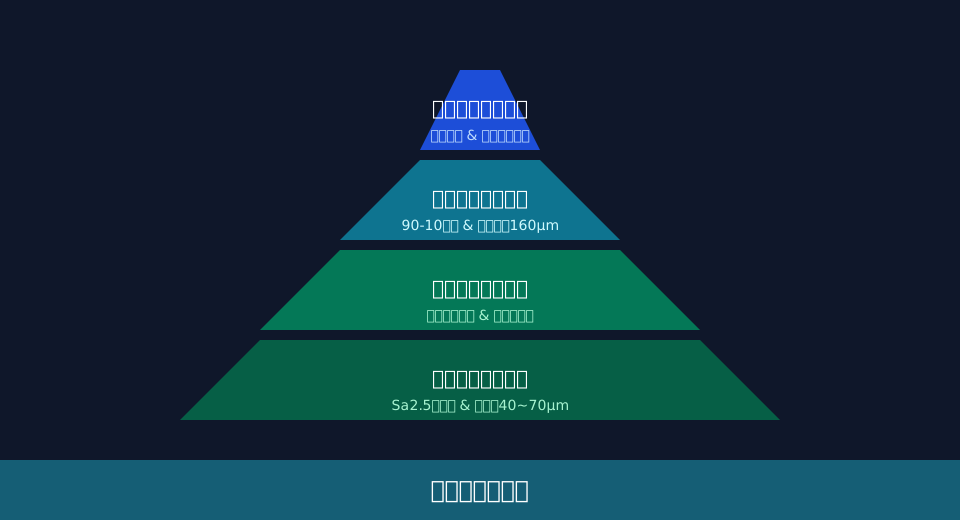
The following sections comprehensively cover the technical details of bridge crane anti-corrosion maintenance from five perspectives: classification of surface treatment grades in workshop environments, matching construction processes for primers and topcoats, coating thickness testing standards, inspection key points for routine maintenance, and cause analysis of common anti-corrosion failures.
The cleanliness and roughness of metal structure surfaces directly determine the adhesion strength between the coating and the substrate. In workshop environments, where spaces are relatively enclosed and dust and corrosive gases tend to accumulate, stricter requirements for surface treatment grades are necessary.
Surface Treatment Grades and Rust Removal Standards in Workshop Environments
According to national standards, surface treatment grades are primarily divided into two categories: blast cleaning and power tool cleaning. In crane manufacturing and overhaul operations, grades Sa2.5 or Sa3.0 are typically required.
During surface treatment, two core indicators must be closely monitored:
First, surface roughness should reach 40–70 μm after sandblasting or shot blasting to provide sufficient mechanical interlocking force.
Second, surface salt content must be controlled within 20 mg/m² to prevent soluble salts from causing corrosion under the coating.
"Industry measured data shows that under the same coating system, steel structures treated to Sa2.5 grade exhibit approximately 40% higher coating adhesion than those treated to St3 grade, extending service life by 2 to 3 times."
⚠️ Note
After sandblasting, the steel surface must be coated with primer within 4 hours. If workshop humidity exceeds 80%, this interval should be reduced to 2 hours to prevent flash rusting.
The table below details the specific parameters and application scenarios for different surface treatment grades, provided for engineering reference.
| Surface TreatmentGrade | Rust removalMethod | surface roughness | ApplicableWorkshopenvironment |
|---|---|---|---|
| Sa2.5Grade | Sandblasting/Shot Blasting | 40~70μm | High Humidity、SevereCorrosion |
| Sa3.0Grade | Sandblasting/Shot Blasting | 50~85μm | Chemical Industry、Marine Climate |
| St3.0Grade | Power Tool | No Significantrequirements | Local Repair、LightCorrosion |
Once surface preparation standards are established, the next critical step is selecting the appropriate coating system and executing the painting process. The chosen coating system directly determines the longevity of the anti-corrosion coating. A scientifically matched application strategy ensures synergistic protection for the equipment.
Primer and Topcoat Application Parameters & Control
Overhead type cranes typically utilize a long-lasting anti-corrosion coating system consisting of an Epoxy Zinc-Rich Primer paired with a Polyurethane Topcoat. The primer provides essential cathodic protection and strong adhesion, while the topcoat shields the structure from UV radiation and chemical erosion.
For large tonnage equipment manufactured by Kelude Heavy Industry, standard specifications typically require a Dry Film Thickness (DFT) of 80 μm for the primer and approximately 60 μm for the topcoat. During construction, the Ambient Temperature must be maintained between 5°C and 35°C, with Relative Humidity kept below 85%.
The following engineering case study illustrates typical paint consumption calculations to assist technical personnel in material planning:
Assume the Main Girder dimensions are 20 m (length) × 1 m (width) × 1.5 m (height). The total surface area S = 2 × (20×1 + 20×1.5 + 1×1.5) = 103 square meters. Using an Epoxy Zinc-Rich Primer with a volume solids content of 50% and a design DFT of 80 μm:
Theoretical Coverage = 50 × 10 / 80 = 6.25 square meters per liter.
Considering a 20% construction loss factor, the actual paint requirement = 103 / 6.25 × 1.2 = 19.8 liters.
💡 Tip
Strictly adhere to the product manual regarding recoating intervals. If the maximum inter-coat interval is exceeded, the surface must be abraded (roughened) to ensure proper layer adhesion.
The table below provides a detailed comparison of various anti-corrosion coating systems, their matching schemes, and expected service life in workshop environments, serving as a reference for selection during the design phase.
📊 Comparison of Anti-Corrosion Coating Systems & Expected Service Life
| coating system | primerType | topcoatType | TotalDry Film Thickness (DFT) | Expectedservice life |
|---|---|---|---|---|
| Standard System | Epoxy Rich-Zinc | Alkyd Enamel | 120μm | 3~5Year(s) |
| Long-Life System | Epoxy Rich-Zinc | Polyurethane Topcoat | 160μm | 8~10Year(s) |
| HeavyAnti-corrosionSystem | Inorganic Zinc-Rich | Fluorocarbon Topcoat (PVDF) | 200μm | 15Years or More |
After the coating application is complete, scientific inspection methods must be employed to verify quality. Dry Film Thickness (DFT) is a core indicator for evaluating anti-corrosion performance; insufficient thickness significantly shortens the anti-corrosion service life.
Weld Crack Detection and Acceptance Criteria Calculation
Magnetic thickness gauges are widely used in engineering for Non-destructive testing. Before measurement, Zero Calibration must be performed on bare, uncoated steel, followed by calibration using standard foils to ensure measurement accuracy.
Acceptance typically follows the 90-10 rule. Specifically, at least five points must be measured per 10 square meters of area. The requirement is that 90% of the measurements must not fall below the specified thickness, while the remaining 10% must not be less than 90% of the specified thickness.
"According to ISO 19840 standards, for a coating with a specified DFT of 160μm, the local thickness must not be lower than 120μm, and the average value of all measurement points must reach or exceed 160μm."
⚠️ Note
Due to surface tension effects, coatings tend to thin out at weld seams, edges, and Bolted Connection areas. Measurements at these locations should be recorded separately, and additional painting passes may be necessary if required.
Anti-corrosion coatings are not a one-time solution. In daily use, vibration, collision, and chemical erosion within the workshop environment can damage the coating. Establishing a comprehensive Inspection system is essential for extending the life of the anti-corrosion system.
Inspection Key Points and Cycle Management Strategies in Routine Maintenance
Within Kelude Heavy Industry's After-Sales Service system, users are typically advised to establish a graded inspection mechanism. Routine inspections are conducted once a month, primarily checking for obvious mechanical damage or localized rust return on the coating surface.
Comprehensive thickness measurement and assessment are performed annually, focusing on stress concentration areas. By integrating main beam weld crack detection technology, coating cracking in weld areas and substrate fatigue issues can be simultaneously troubleshooted.
The following two areas require special attention during inspection:
First, the High-Strength Bolt nodes connecting the Main Girder and End Carriage. This area tends to accumulate moisture and dust, leading to higher corrosion rates.
Second, the vicinity of the trolley rail clamping plate. Due to long-term friction from Wheel load, the coating is prone to Wear and spalling.
💡 Tip
When planning the workshop layout, fully consider the anti-collision safety distance for cranes to avoid severe collisions during operation, thereby reducing micro-cracks in the coating caused by structural deformation.
Despite strict construction and inspection measures, coating Failure symptoms may still appear after long-term service. Analyzing the causes of failure and adopting correct repair strategies are critical components of maintenance work.
Cause Analysis of Common Anti-Corrosion Coating Failures and Local Repair Plans
Common coating failure forms include blistering, spalling, and chalking. Blistering is usually caused by residual soluble salts on the surface or excessively high humidity during painting; spalling is often due to insufficient Rust removal grades or decreased Adhesion between layers.
Kelude Heavy Industry's technical team found through analyzing multiple failure cases that alternating stress generated by structural sway is also a significant cause of micro-cracks in coatings. Introducing AI anti-sway algorithm to reduce structural sway stress reduced the occurrence rate of coating micro-cracks by approximately 30%.
When performing local repairs, the following two principles must be followed:
First, Adhesion testing: The coating adhesion in the repair area must exceed 5MPa before topcoat coverage can proceed.
Second, repair area control: If the local failure area exceeds 0.5 square meters, it is recommended to grind down and repaint the entire area to avoid visible overlap marks.
"During on-site repair, the overlap width between old and new coatings should remain above 50mm, and the overlap area requires feathering treatment to ensure smoothness and sealing in the transition zone."
⚠️ Note
During local patching, a paint system compatible with the original coating must be used. It is strictly prohibited to cover alkyd topcoats directly over epoxy primers, as this will cause severe undercutting.
FAQ
Q: Can I apply a topcoat directly over slight rust return on the Workshop crane surface?
A: No. Light rusting indicates that the primer has failed; covering it directly will cause corrosion to spread beneath the coating. You must first use power tools to grind the affected areas to St3 standard, revealing a metallic luster. Then, apply the same type of primer and allow it to cure before applying the topcoat.
Q: What are the specific temperature and humidity requirements for the workshop environment during anti-corrosion coating application?
A: The ambient temperature should be controlled between 41°F (5°C) and 95°F (35°C), with relative humidity below 85%. The steel plate surface temperature must be at least 5.4°F (3°C) above the dew point to prevent condensation, which can reduce coating adhesion or cause blistering defects.
Q: How much does the initial investment cost increase when using a heavy-duty anti-corrosion coating system compared to a conventional one?
A: Due to the use of Inorganic Zinc Silicate Primer and Fluorocarbon Topcoat (PVDF), material costs are higher, making the initial investment typically 1.5 to 2 times that of conventional systems. However, the longer maintenance cycle results in better overall life cycle cost control. Specific amounts are subject to the actual contract.
Q: How are the calibration frequency and measurement points for Dry Film Thickness (DFT) detection regulated?
A: The thickness gauge must be calibrated with standard foils before each use. Measurements follow the 90-10 rule: at least 5 readings per 107.6 sq ft (10 m²), where 90% of values must meet or exceed the specified thickness, and the remaining 10% must not fall below 90% of the specified thickness.
Anti-corrosion maintenance for overhead type cranes is a systematic engineering process. From controlling surface treatment grades to precise management of coating application, every link directly impacts equipment safety and service life. Kelude Heavy Industry consistently prioritizes structural anti-corrosion in the design and manufacturing of heavy load cranes, providing highly reliable Material Handling solutions through scientific coating systems and strict process standards.
