

AI-Based Fault Diagnosis for Overhead Crane Motors: Vibration Spectrum Analysis and 1D-CNN Intelligent Recognition
Over 30% of all crane motor failures—including bearing wear, rotor bar breakage, and stator short circuits—directly impact production whenever any one of these issues occurs. Most factories still follow a ”replace when broken” maintenance strategy, waiting until a motor starts smoking or trips the circuit breaker before shutting down production. The cost of a single unplanned shutdown ranges from a few thousand to tens of thousands.
AI-based fault diagnosis is nothing new, but in the past it relied primarily on expert systems (rules + thresholds), which had high false positive rates and poor adaptability. In the past two years, 1D-CNNs (one-dimensional convolutional neural networks) have proven remarkably effective in vibration signal analysis—by attaching vibration sensors to motor bearing housings and feeding the collected signals directly into the model, there is no need for manual feature extraction; the model learns the failure patterns on its own. Each motor is equipped with 2–3 sensors, with inference running on an industrial control computer; a single system can manage 10–20 motors.
This article outlines a comprehensive solution, from sensor selection to model deployment. The hardware investment ranges from 20,000 to 60,000 (including sensors, data acquisition cards, and an industrial PC), and the cost can be recouped in just one year through savings on unplanned downtime for a single motor.
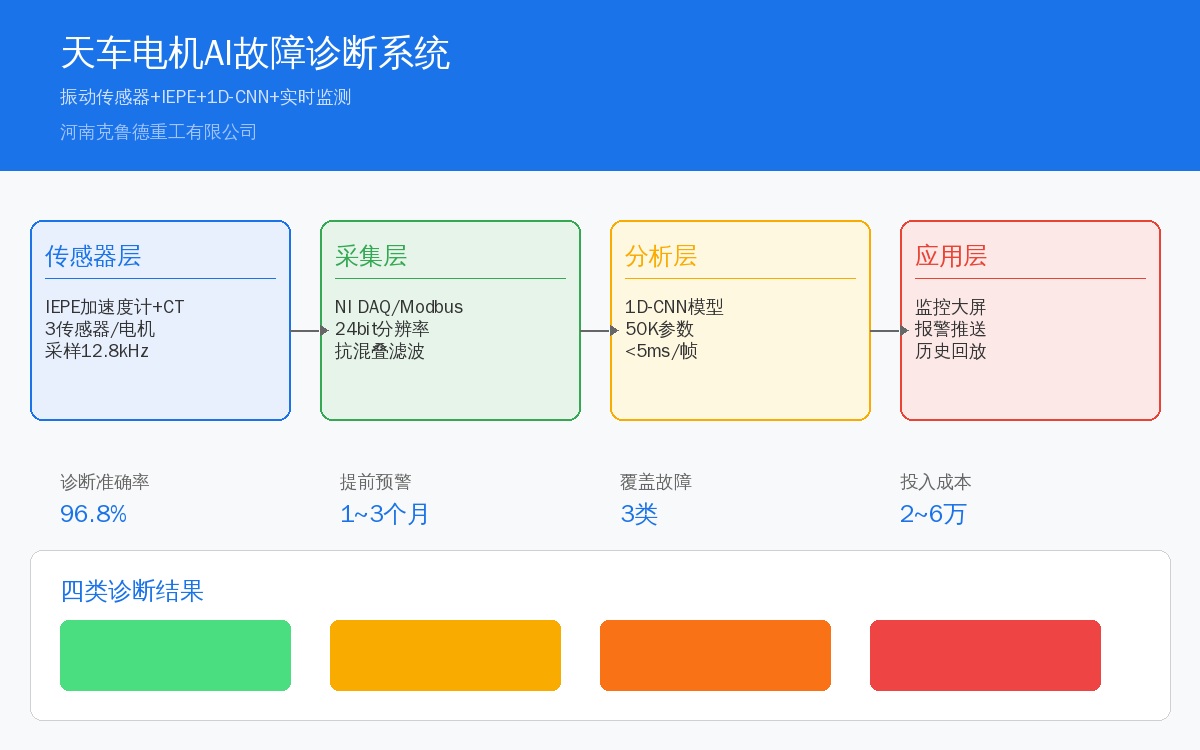
I. System Architecture
The motor AI diagnostic system consists of four layers:
| Level | Features | Core Components | Technical Indicators |
|---|---|---|---|
| Perception Layer | Vibration + Current Signal Acquisition | IEPE Accelerometer + CT | Sampling rate: 12.8 kHz per channel |
| Acquisition Layer | Signal Conditioning + A/D Conversion | NI DAQ/Modbus RTU Acquisition Module | 24-bit resolution, anti-aliasing filter |
| Analysis Layer | Feature Extraction + AI Inference | Industrial PC + 1D-CNN Model | Single frame 961 TP3T |
| Application Layer | Status Display + Alert Notifications | Monitoring Display + WeChat/SMS Notifications | Real-time updates with historical playback support |
II. Sensor Selection and Installation
Vibration Sensor:We recommend IEPE-type piezoelectric accelerometers with a sensitivity of 100 mV/g, a measurement range of ±50 g, and a frequency response of 0.5–10 kHz. Installation locations: bearing housing on the drive end (one each for radial and axial directions) and bearing housing on the non-drive end (one for the radial direction). Mounting options include M6 bolts or magnetic mounts—magnetic mounts are convenient but have a lower upper frequency limit (approximately 2 kHz), whereas bolt mounting can reach 10 kHz. Bolt mounting is recommended; although it takes an extra 10 minutes, the signal quality in the high-frequency range is significantly better.
Current Sensors:Clamp-on current transformer, accuracy class 0.5; the range should be selected based on 1.5 times the motor’s rated current. It is installed on the three-phase power lines to detect changes in current harmonics caused by broken rotor bars.
Key Sensor Parameters:
| Parameters | Vibration Sensor | Current Sensor |
|---|---|---|
| Model | PCB 352C33 / B&K 4397 | LEM LF 305-S |
| Sensitivity | 100 mV/g | — |
| Measurement Range | ±50 g | 0–300 A |
| Frequency Range | 0.5–10,000 Hz | DC–10 kHz |
| Installation Methods | Bolt/M6 Magnetic Mount | Clamp-type gripping |
| Unit Price | Approximately 800–1,500 yuan | About 500 yuan |
| Protection Rating | IP65 | IP40 |
III. Design and Training of the 1D-CNN Model
The key advantage of the 1D-CNN is that it directly processes the raw vibration time-domain signal (1024 points per frame) without requiring manual feature extraction methods such as FFT or wavelet transforms. The network architecture is as follows:
import torch.nn as nn

class MotorCNN1D(nn.Module):
    def __init__(self, num_classes=4):
    super().__init__()
        self.conv1 = nn.Sequential(
 nn.Conv1d(1, 16, kernel_size=64, stride=8),
 nn.ReLU(), nn.MaxPool1d(2))
        self.conv2 = nn.Sequential(
 nn.Conv1d(16, 32, kernel_size=32, stride=4),
 nn.ReLU(), nn.MaxPool1d(2))
        self.conv3 = nn.Sequential(
 nn.Conv1d(32, 64, kernel_size=16, stride=2),
 nn.ReLU(), nn.AdaptiveAvgPool1d(1))
        self.fc = nn.Linear(64, num_classes)

    def forward(self, x):
 x = self.conv1(x)
 x = self.conv2(x)
 x = self.conv3(x).squeeze()
 return self.fc(x)
Training dataset configuration: Normal operating conditions + three types of faults (bearing wear, rotor bar breakage, stator short circuit), with 2,000 samples per category (1,024 points per frame), split into training, validation, and test sets at a ratio of 7:2:1. Training hyperparameters: batch=64, lr=0.001, epochs=100, Adam optimizer. Training took approximately 15 minutes on an RTX 3060, with a test set accuracy of 96.81% (TP3T).
# Inference Code
model.eval()
with torch.no_grad():
    output = model(sensor_data.unsqueeze(0).unsqueeze(0))
    pred = torch.argmax(output, dim=1).item()
    confidence = torch.softmax(output, dim=1)[0][pred].item()

classes = {0: "Normal", 1: "Bearing Wear", 2: "Rotor Bar Break", 3: "Stator Short Circuit"}
print(f"Diagnosis: {classes[pred]} (Confidence: {confidence:.1%})")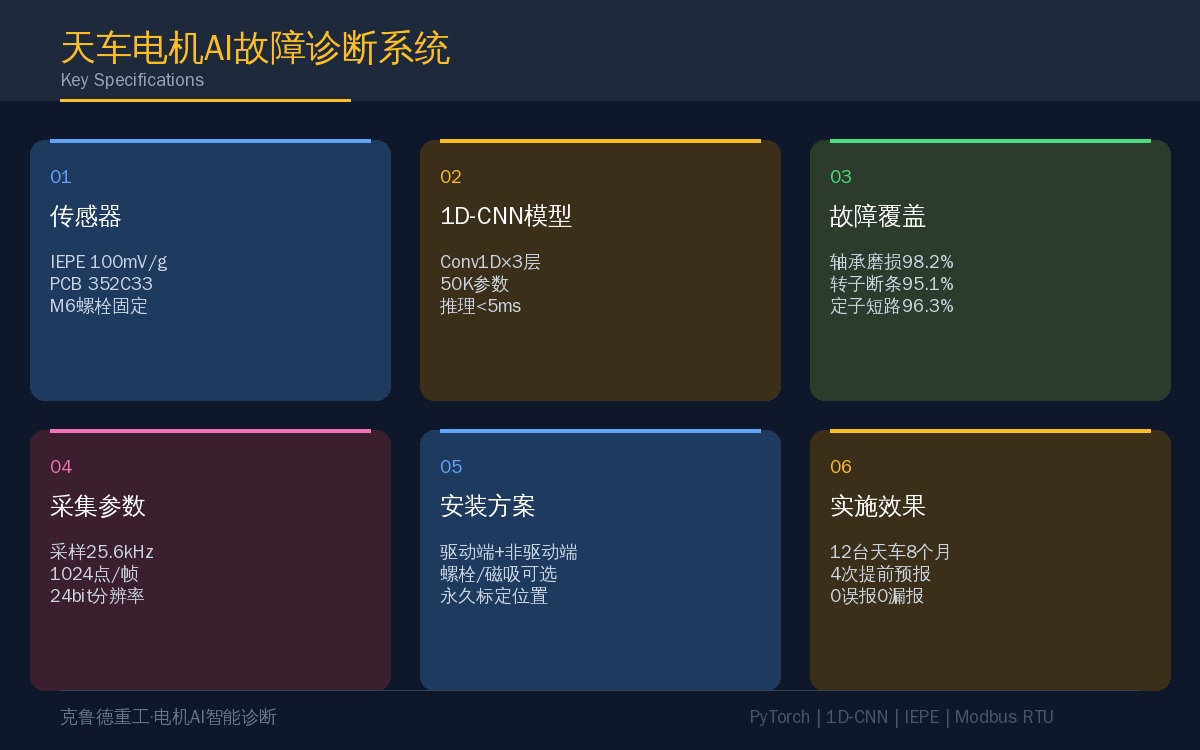
IV. Failure Modes and Characteristics
| Fault Type | Vibration Characteristics | Characteristic Frequency Bands | AI Recognition Accuracy |
|---|---|---|---|
| Bearing Wear | High-frequency vibration energy increases, and sidebands appear | 2–8 kHz | 98.2% |
| Rotor Bar Breakage | 1x frequency-shifted sideband, with significantly increased high-frequency components | 0–100 Hz | 95.1% |
| Stator Short Circuit | Increase in the 2x power frequency component; abnormal magnetic field harmonics | 100–300 Hz | 96.3% |
| Normal | The spectrum is clean, with no obvious anomalous peaks. | Full-range | 99.5% |
V. Key Points for Project Implementation
1. A higher sampling rate isn't necessarily better. The relevant information in motor vibration signals is concentrated below 10 kHz, so a sampling rate of 25.6 kHz is sufficient (2.56 times the Nyquist criterion). Setting the sampling rate too high causes the data volume to skyrocket, but the model’s accuracy actually decreases rather than increases because high-frequency noise is introduced.
2. The installation location determines data quality. Sensors mounted directly above the bearing housing and on the side of the motor housing may exhibit signal amplitude differences of 3 to 5 times. Once the installation position is fixed, do not move the sensors arbitrarily, as this may cause a baseline shift and result in false alarms.
3. Speed fluctuations need to be normalized. The overhead crane motor is speed-controlled via a variable-frequency drive, with speeds ranging from 100 rpm to 1,500 rpm. The vibration frequency associated with the same fault varies depending on the speed. Solution: Perform order tracking on each sample to map the spectrum from the absolute frequency domain to the order domain.
4. Don't rely solely on vibration. Combined vibration and current diagnostics are approximately 5 percentage points more accurate than vibration-only diagnostics. For example, the characteristics of a broken rotor bar are more pronounced in the current signal than in the vibration signal. It is recommended that each motor be equipped with at least one current sensor.
5. Regularly upload data to update the model. We recommend adding newly collected normal samples to the training set each month for incremental training, so that the model can continuously adapt to device aging trends.
Conclusion
CombinedAI Large Model Operations AssistantThe cost-effectiveness of AI-based motor fault diagnosis is the highest among all intelligent upgrades for overhead cranes. The cost of sensors and data acquisition for a single motor is less than 3,000 yuan, yet it can predict failures 1 to 3 months in advance. After running the system for eight months on 12 overhead cranes in one workshop, it successfully predicted bearing failures in four motors in advance—with no false positives and no missed detections.
Further Reading:Fault Diagnosis Techniques for Overhead Crane Gearboxes—Motors and gearboxes are two sides of the same coin in an overhead crane’s drive system—Motor AI fault diagnosis covers bearing, rotor, and stator faults on the drive side, while gearbox fault diagnosis covers the gear meshing side. Both share the same industrial PC platform and sensor data acquisition architecture, and it is recommended that they be deployed simultaneously.
Frequently Asked Questions
Q: What sensors does the AI system for diagnosing overhead crane motor faults require?
Answer: You will need a vibration accelerometer (IEPE type, sensitivity 100 mV/g, range ±50 g) and a current transformer (accuracy class 0.5). We recommend installing two vibration sensors (on the drive end and non-drive end bearing housings) and one current sensor per motor. A set of three sensors costs approximately 3,000–5,000 yuan.
Q: What is the difference between AI diagnostics and traditional protectors?
Answer: Traditional thermal relays and motor protectors can only detect overcurrent, overload, and phase loss—all of which are indicators that a fault has already occurred. AI diagnostics, through vibration spectrum analysis, can detect early signs of a fault 1 to 3 months before it occurs.
Q: Which performs better, 1D-CNN or 2D-CNN?
Answer: For one-dimensional time-series data such as vibration signals, a 1D-CNN is more suitable. It directly processes the raw time-domain signal, resulting in a smaller model (approximately 50K parameters) and faster inference (<5 ms per frame). 2D-CNNs require converting the vibration signal into a time-frequency spectrum first; while they have 10 times as many parameters, the improvement in accuracy is limited.
