

Design and Selection of Overhead Crane Hoisting Mechanisms and Wheel Assemblies: A Comprehensive Analysis of Drum Assemblies, Pulley Blocks, and Wheel Materials
The hoisting mechanism is the core executive system that enables a crane to perform lifting operations; it consists of a drum assembly, a block and tackle, a gearbox, and a brake. The wheel set, on the other hand, serves as the load-bearing foundation that enables the crane to move. This article systematically analyzes the calculation of drum diameter and wall thickness verification, the selection of sheaves and wear standards, as well as the materials and heat treatment processes for wheels, in accordance with the GB/T 3811-2024 standard, and provides comprehensive design parameters and engineering data.
I. Reel Assembly Design
The drum is the core rotating component in a hoisting mechanism that winds the steel wire rope and transmits driving force. The drum diameter is calculated according to the formula D ≥ (h₁ × h₂) × d in GB/T 3811-2024, where h₁ is a coefficient related to the duty class (16 for A5, 20 for A7), h₂ is a coefficient related to the wire rope structure (1.0 for cross-laid ropes), and d is the wire rope diameter. A larger drum diameter results in lower bending stress on the wire rope and a longer service life, but it also increases the drum’s size and weight. In engineering practice, the smaller value is typically selected—provided the safety factors are met—to reduce the overhead crane’s dead weight.
| Job Level | h₁ coefficient | Recommended D/d Ratio |
|---|---|---|
| A3–A4 (Mild) | 14 | ≥14×d |
| A5 (Intermediate) | 16 | ≥16×d |
| A6 (Heavyweight) | 18 | ≥18×d |
| A7–A8 (Extra Heavy Class) | 20 | ≥20×d |
The following is a quick reference table for selecting drums based on different wire rope diameters, including recommended wall thicknesses:
| Wire Rope Diameter | A5 Roll Diameter | A7 Reel Diameter | Cast Iron Wall Thickness | Cast Steel Wall Thickness |
|---|---|---|---|---|
| ∅14 mm | ∅224 mm | ∅280 mm | 16 mm | 12 mm |
| ∅18mm | ∅280 mm | ∅355 mm | 18 mm | 14 mm |
| ∅22 mm | ∅355 mm | ∅450 mm | 22 mm | 16 mm |
| ∅28 mm | ∅450 mm | ∅560 mm | 28 mm | 20 mm |
| ∅32 mm | ∅500 mm | ∅630 mm | 32 mm | 24 mm |
| ∅36mm | ∅560 mm | ∅710 mm | 36 mm | 26 mm |
The strength verification of the drum is based primarily on wall pressure stress. Taking a 50-metric-ton overhead crane as an example (∅28 mm wire rope, drum ∅560 mm, wall thickness 20 mm, material ZG270-500, maximum tension 130 kN), the wall pressure stress is approximately 92.5 MPa, with an allowable stress of 125 MPa (safety factor 4), resulting in a safety margin of 261 TP3T. The rope groove parameters comply with the GB/T 3811 standard: groove bottom radius R = (0.53–0.56) × d, groove depth h ≥ 0.35 × d, and pitch s = d + (2–4) mm.
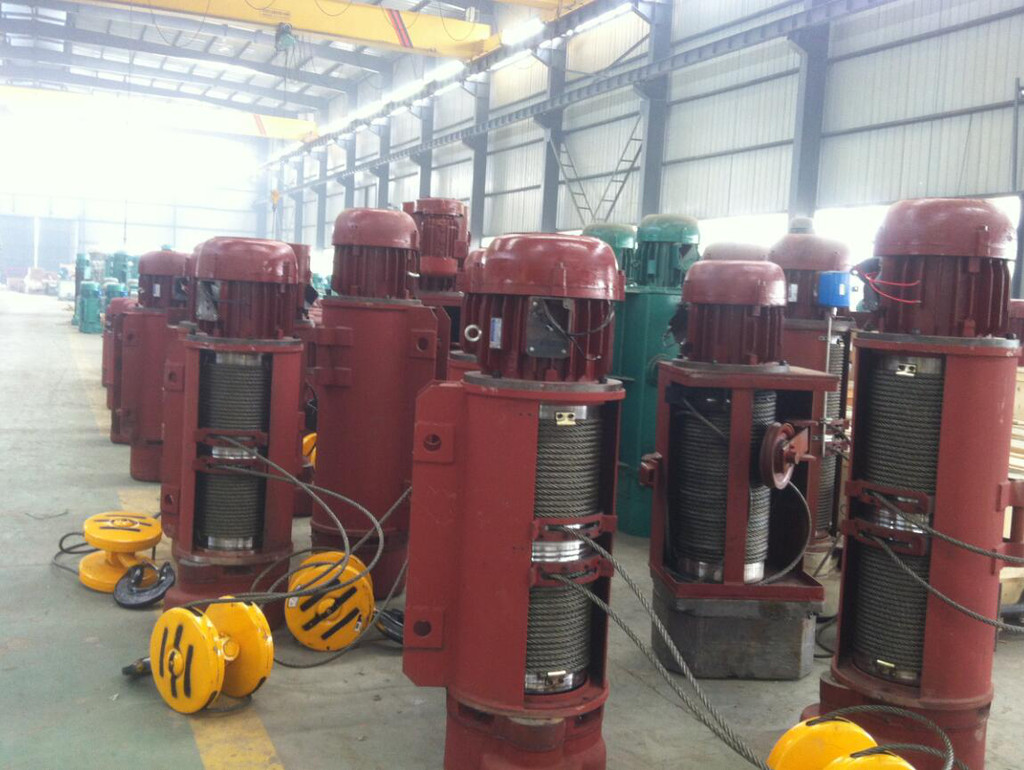
II. Pulley System Design
The sheave diameter D_sheave must be ≥ (h₃ × h₂) × d, where the h₃ coefficient is: 16 for grades A3–A4, 18 for grade A5, 20 for grade A6, and 22.4 for grades A7–A8. Quick Selection Examples: ∅14 mm rope paired with a ∅280 mm pulley (Class A5); ∅28 mm rope paired with a ∅560 mm pulley; ∅32 mm rope paired with a ∅630 mm pulley.
Recommended pulley materials: For A5 and below, use HT200 cast iron (low cost); for A6 and above, use ZG270-500 cast steel (high strength, impact resistance). For high-speed overhead cranes, rolled steel pulleys (lightweight) may be used. Self-aligning roller bearings are recommended for pulleys; their self-aligning capability allows them to withstand off-center loads. They should be greased once a month and have a service life of 5,000–10,000 hours. Pulleys Groove Wear Standards: Replace the pulley if the wear on the groove bottom radius exceeds 20% of the original dimension or if the wear on the groove wall thickness exceeds 20%. If the radial runout of the groove exceeds 1 mm, it can be repaired by turning.
III. Wheel Assembly Design and Materials
An overhead crane wheel assembly consists of a wheel, an angular bearing housing, and an axle. The choice of wheel material directly affects load-carrying capacity and service life, and the heat treatment process is key to ensuring the wheel’s wear resistance.
| Parts | Recommended Materials | Heat Treatment Methods | Hardness Requirements | Hardening Layer Depth |
|---|---|---|---|---|
| Tread | ZG50Mn2/ZG50MnMo | Surface Hardening (Medium-Frequency/Flame) | HB 350–450 | 10–20 mm |
| Wheel Flange | ZG50Mn2/ZG50MnMo | Surface Hardening | HB 300–380 | 8–15 mm |
| Gear Tooth Surface | 40Cr/42CrMo | Tooth Surface Hardening/Carburizing | HRC 50–58 | 1–2 mm |
| Gear core | 40Cr/42CrMo | Quenching and Tempering | HB 250–300 | All over |
| Reel | ZG270-500 | Normalizing + Tempering | HB 160–220 | All over |
| Pulley | HT200/ZG270-500 | Stress-Relief Annealing | — | — |
The wheel tread is surface-hardened using medium-frequency induction hardening to achieve a hardness of HB 350–450, with a hardened layer depth of 10–20 mm, enabling it to withstand the contact stresses between the wheel and the rail. The flange hardness is HB 300–380, which is slightly lower than that of the tread to reduce the risk of crack propagation during wear. The gear tooth surfaces are carburized and quenched to achieve a high hardness of HRC 50–58, while the core is normalized to HB 250–300 to maintain toughness. For wheel wear detection, reference can be made to the experience gained from online inspection technology for overhead crane steel wires (seeOverhead Crane Wire Rope Inspection Technology)。
IV. Brake Configuration for the Hoisting Mechanism
Safety braking for hoisting mechanisms is a mandatory requirement under GB/T 3811-2024. Hoisting mechanisms must be equipped with two independent brakes—one on the high-speed shaft (at the motor end) and one on the low-speed shaft (at the drum end). The high-speed shaft brake is used for normal service braking, while the low-speed shaft safety brake serves as a second line of defense for emergency braking and to prevent the load from falling. For hoisting mechanisms rated Class A6 or higher, hydraulic push-rod brakes are recommended, with the braking torque designed to be 1.5 times the rated load.
Regular inspections and maintenance of brakes can be monitored in real time using the overhead crane digital remote monitoring platform (seeDigital Remote Monitoring Solution for Overhead Cranes), enabling predictive maintenance by monitoring parameters such as the number of brake actuations, braking time, and brake temperature rise.
V. Krude Heavy Industry Machinery Parts Solutions
Krude Heavy Industry’s overhead crane mechanical components include drum assemblies (HT200/ZG270-500/Q345B welded drums), pulley blocks (HT200/ZG270-500/rolled steel pulleys) , wheel assemblies (ZG50Mn2/ZG50MnMo surface-hardened), gear reducers, couplings, and brakes. All components comply with the GB/T 3811-2024 and GB/T 10051 standards, and come with complete strength verification reports and heat treatment process documentation. Krude Heavy Industry offers free technical consultation and component selection services.
Frequently Asked Questions
问:天车起升机构卷筒组如何选型?
A:卷筒直径一般取钢丝绳直径的20~30倍,卷筒长度根据起升高度和钢丝绳倍率计算。常用卷筒材料为Q235B或Q355B,大吨位卷筒采用ZG270-500铸钢。卷筒壁厚需按GB/T 3811进行强度校核。
问:天车轮组材料如何选择?
A:车轮常用材料为ZG340-640、ZG35CrMo或42CrMo。工作级别A5以下推荐ZG340-640,A6以上推荐ZG35CrMo调质处理。车轮踏面硬度需达到HB300~380,以保证耐磨性。
问:起升机构设计执行哪些标准?
A:设计按GB/T 3811《起重机设计规范》,卷筒按JB/T 9005.1,滑轮按JB/T 9005.2,车轮按JB/T 6392执行。
